


In the realm of scientific exploration, few fields are as inherently dynamic and visually compelling as the study of complex fluids. These substances, which defy simple categorization, exhibit behaviors that are both intricate and essential to numerous industrial and biological processes. At the forefront of this research is Associate Professor Patrick Spicer of the University of New South Wales (UNSW), whose work bridges the gap between fundamental science and practical application. This portrait, titled "Fluid Dynamics: A Portrait of Innovation", seeks to encapsulate both the essence of Professor Spicer's contributions and the fluidity inherent in his field of expertise.
Associate Professor Patrick Spicer is a leading figure in the study of complex fluids. As a member of UNSW's School of Chemical Engineering, he directs the Complex Fluids group, a team dedicated to understanding the behavior of fluids with complex microstructures. His research spans a wide array of applications, including the development of smart fluids for consumer products, medical devices, and industrial processes. Through his work, Professor Spicer has advanced our ability to design fluids that respond predictably to external stimuli—a crucial innovation for industries ranging from pharmaceuticals to food production.
Professor Spicer is also a mentor and educator, guiding the next generation of scientists and engineers. His leadership in the Chemical Product Engineering stream and the Fluids Foundry Chemical Engineering Makerspace underscores his commitment to fostering innovation and collaboration. Through these initiatives, he provides students and researchers with the tools and environment necessary to translate theoretical knowledge into tangible solutions.
The portrait presented here is more than a mere likeness; it is a visual narrative that intertwines the subject’s identity with the essence of his work. Professor Spicer is depicted leaning against a plinth from which a chrome tap extends into a bowl, a single drop poised to fall. This moment captures the potential for discovery—the instant before transformation—a concept central to the study of complex fluids.
For me, as a 3D portrait artist, this scene resonates profoundly. My process begins with a liquid medium: resin, a fluid that can flow, spread, and conform. Through careful manipulation and curing, this fluid transforms into a solid, three-dimensional object—a process that mirrors, in its own way, the study of fluids and their behaviors. This interplay between fluidity and form—the journey from liquid to structured, tactile reality—parallels the scientific principles that Professor Spicer investigates. Both art and science celebrate the possibilities inherent in movement, change, and transformation.
The chrome tap and red bowl further reinforce this narrative. They symbolize precision, clarity, and the controlled manipulation of matter, echoing both the laboratory and the artist’s studio. The fluid splash beneath the bowl captures the unpredictable yet patterned behavior of complex fluids, highlighting the balance between chaos and order that defines this field.
Art and science, often perceived as separate disciplines, share a foundation in curiosity and exploration. This portrait demonstrates how artistic expression can illuminate scientific concepts, rendering them accessible and compelling to a broader audience. By visualizing fluid dynamics in a literal and metaphorical sense, the work invites viewers to appreciate both the beauty of physical phenomena and the creativity involved in scientific investigation.
Moreover, the transformation from liquid to solid in my sculptural process emphasizes the tangible outcomes of experimentation—whether in the lab or the studio. It reminds us that discovery is not only conceptual but also material: ideas become objects, theories become forms, and fluid behaviors become frozen, comprehensible moments of art.
"Fluid Dynamics: A Portrait of Innovation" celebrates the intersection of science and art, honoring Associate Professor Patrick Spicer’s contributions to the study of complex fluids while reflecting the dynamic nature of my artistic process. The work encapsulates the journey from fluidity to form, from potential to structure, echoing both the scientific investigations of Professor Spicer and the transformative power of artistic creation. Through this portrait, viewers are invited to contemplate the shared creativity of science and art, and the beauty that emerges when fluidity becomes form.
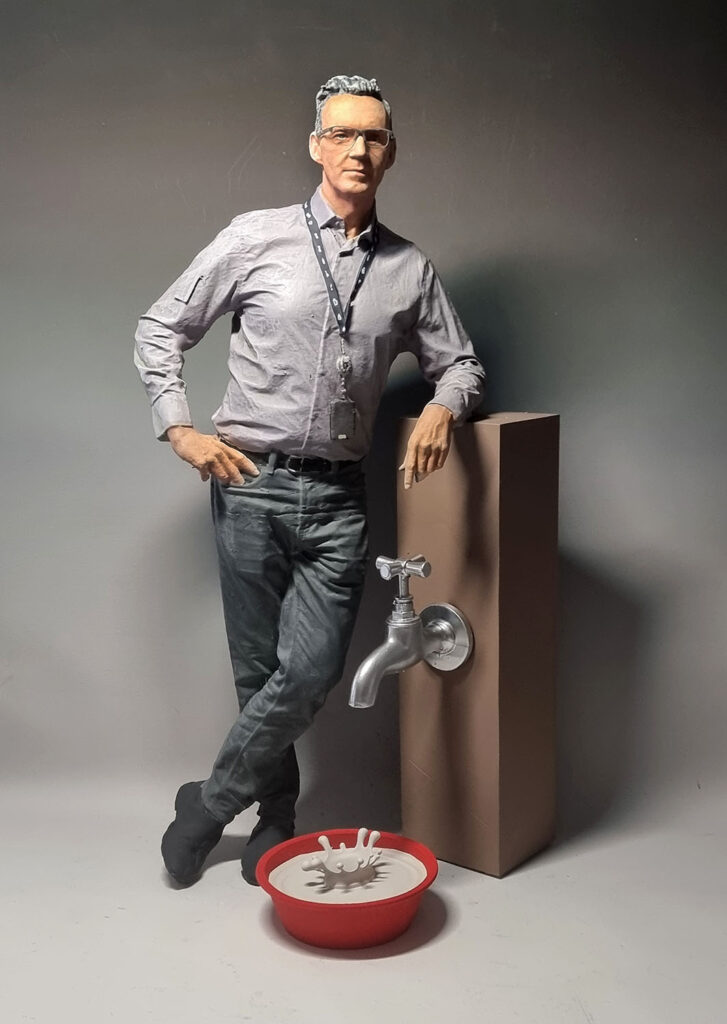
Associate Professor Patrick Spicer - UNSW - "Fluid Dynamics"
In the realm of scientific exploration, few fields are as inherently dynamic and visually compelling as the study of complex fluids. These substances, which defy simple categorization, exhibit behaviors that are both intricate and essential to numerous industrial and biological processes. At the forefront of this research is Associate Professor Patrick Spicer of the University of New South Wales (UNSW), whose work bridges the gap between fundamental science and practical application. This portrait, titled "Fluid Dynamics: A Portrait of Innovation", seeks to encapsulate both the essence of Professor Spicer's contributions and the fluidity inherent in his field of expertise.
Associate Professor Patrick Spicer is a leading figure in the study of complex fluids. As a member of UNSW's School of Chemical Engineering, he directs the Complex Fluids group, a team dedicated to understanding the behavior of fluids with complex microstructures. His research spans a wide array of applications, including the development of smart fluids for consumer products, medical devices, and industrial processes. Through his work, Professor Spicer has advanced our ability to design fluids that respond predictably to external stimuli—a crucial innovation for industries ranging from pharmaceuticals to food production.
Professor Spicer is also a mentor and educator, guiding the next generation of scientists and engineers. His leadership in the Chemical Product Engineering stream and the Fluids Foundry Chemical Engineering Makerspace underscores his commitment to fostering innovation and collaboration. Through these initiatives, he provides students and researchers with the tools and environment necessary to translate theoretical knowledge into tangible solutions.
The portrait presented here is more than a mere likeness; it is a visual narrative that intertwines the subject’s identity with the essence of his work. Professor Spicer is depicted leaning against a plinth from which a chrome tap extends into a bowl, a single drop poised to fall. This moment captures the potential for discovery—the instant before transformation—a concept central to the study of complex fluids.
For me, as a 3D portrait artist, this scene resonates profoundly. My process begins with a liquid medium: resin, a fluid that can flow, spread, and conform. Through careful manipulation and curing, this fluid transforms into a solid, three-dimensional object—a process that mirrors, in its own way, the study of fluids and their behaviors. This interplay between fluidity and form—the journey from liquid to structured, tactile reality—parallels the scientific principles that Professor Spicer investigates. Both art and science celebrate the possibilities inherent in movement, change, and transformation.
The chrome tap and red bowl further reinforce this narrative. They symbolize precision, clarity, and the controlled manipulation of matter, echoing both the laboratory and the artist’s studio. The fluid splash beneath the bowl captures the unpredictable yet patterned behavior of complex fluids, highlighting the balance between chaos and order that defines this field.
Art and science, often perceived as separate disciplines, share a foundation in curiosity and exploration. This portrait demonstrates how artistic expression can illuminate scientific concepts, rendering them accessible and compelling to a broader audience. By visualizing fluid dynamics in a literal and metaphorical sense, the work invites viewers to appreciate both the beauty of physical phenomena and the creativity involved in scientific investigation.
Moreover, the transformation from liquid to solid in my sculptural process emphasizes the tangible outcomes of experimentation—whether in the lab or the studio. It reminds us that discovery is not only conceptual but also material: ideas become objects, theories become forms, and fluid behaviors become frozen, comprehensible moments of art.
"Fluid Dynamics: A Portrait of Innovation" celebrates the intersection of science and art, honoring Associate Professor Patrick Spicer’s contributions to the study of complex fluids while reflecting the dynamic nature of my artistic process. The work encapsulates the journey from fluidity to form, from potential to structure, echoing both the scientific investigations of Professor Spicer and the transformative power of artistic creation. Through this portrait, viewers are invited to contemplate the shared creativity of science and art, and the beauty that emerges when fluidity becomes form.