


Few artists changed the direction of modern art as profoundly as Pablo Picasso. Restless, inventive and endlessly experimental, Picasso helped redefine what painting could be in the twentieth century. From the fractured forms of Cubism to the emotional intensity of works such as Guernica, his influence reached far beyond painting and into sculpture, printmaking, ceramics and modern visual culture itself.
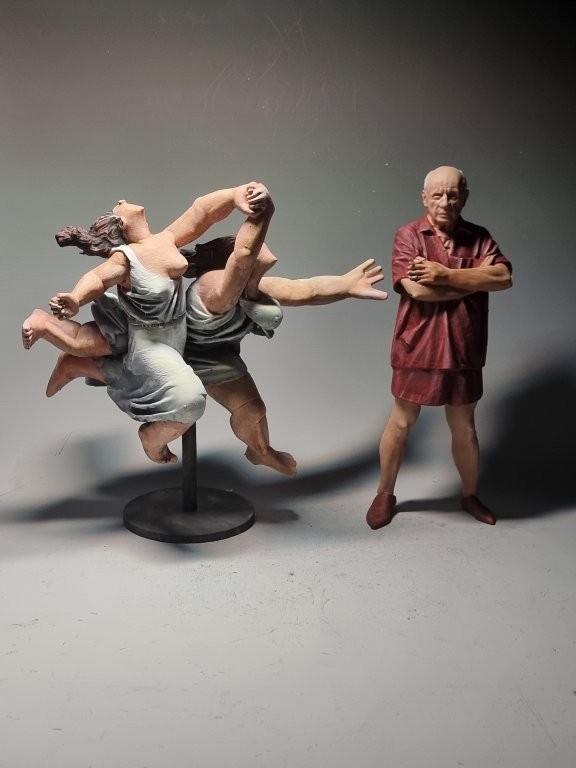
This 3D portrait explores Picasso not simply as a historical figure, but as a creative force still very much alive within contemporary art. The figure is paired with elements inspired by his famous “running women” imagery, allowing the work to move beyond straightforward portraiture into a small theatrical scene — something between sculpture, painting and memory.
Part of an ongoing series of hand-painted 3D portraits by Australian artist Simon Fieldhouse, the work combines digital modelling and traditional painterly techniques to create a contemporary interpretation of cultural icons. Rather than aiming for photographic perfection, the piece embraces visible brushwork and sculptural texture, echoing the spontaneity and energy that made Picasso such a revolutionary figure.
In many ways, the work is also a conversation across generations: twentieth-century modernism reinterpreted through twenty-first-century technology and handcrafted miniature sculpture.
Picasso
Few artists changed the direction of modern art as profoundly as Pablo Picasso. Restless, inventive and endlessly experimental, Picasso helped redefine what painting could be in the twentieth century. From the fractured forms of Cubism to the emotional intensity of works such as Guernica, his influence reached far beyond painting and into sculpture, printmaking, ceramics and modern visual culture itself.
This 3D portrait explores Picasso not simply as a historical figure, but as a creative force still very much alive within contemporary art. The figure is paired with elements inspired by his famous “running women” imagery, allowing the work to move beyond straightforward portraiture into a small theatrical scene — something between sculpture, painting and memory.
Part of an ongoing series of hand-painted 3D portraits by Australian artist Simon Fieldhouse, the work combines digital modelling and traditional painterly techniques to create a contemporary interpretation of cultural icons. Rather than aiming for photographic perfection, the piece embraces visible brushwork and sculptural texture, echoing the spontaneity and energy that made Picasso such a revolutionary figure.
In many ways, the work is also a conversation across generations: twentieth-century modernism reinterpreted through twenty-first-century technology and handcrafted miniature sculpture.