St Martin-in-the-Fields – A Landmark of Sacred Architecture and Modern Renewal
St Martin-in-the-Fields stands proudly at the northeast corner of Trafalgar Square in London, a building that unites classical design, spiritual tradition, and contemporary artistic vision. The current structure, completed in 1726, was the work of architect James Gibbs, whose neoclassical approach introduced a strong, symmetrical portico and an elegantly tapering spire — elements that would go on to influence ecclesiastical architecture throughout the English-speaking world. Its design is at once grounded and uplifting, a confident expression of civic pride and sacred purpose.
Though the church’s roots stretch back to the medieval period, this incarnation of St Martin’s has become one of London’s most recognisable buildings, a fixture not just of Trafalgar Square but of the city’s architectural identity. Gibbs’s work harmonises robust geometry with delicate detail, using clean lines and thoughtful proportions to create a sense of openness and calm. The church’s prominent position beside the National Gallery ensures it remains at the heart of London’s cultural and spiritual life.
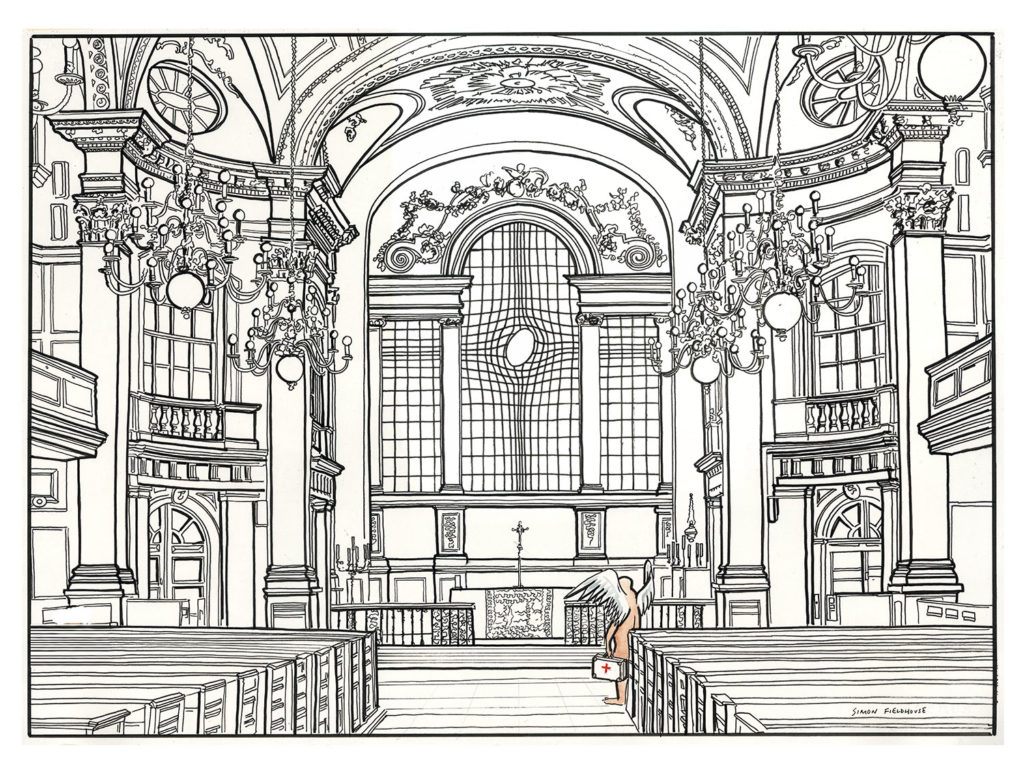
Yet what sets St Martin-in-the-Fields apart is its openness to renewal. This is perhaps most evident in the East Window — a dramatic, modern reinterpretation of traditional stained glass. Installed in 2008 as part of an ambitious renovation of the church, the window was designed by Iranian-born British artist Shirazeh Houshiary in collaboration with architect Pip Horne. Rather than depicting saints or narrative scenes, the work consists of multiple clear glass panels arranged in a grid, their surfaces etched and subtly distorted. At the centre is a quiet oval void, through which daylight softly pours.
This abstract composition suggests the form of a cross, but it does so through light, shadow, and suggestion rather than literal representation. The effect is meditative and restrained. As sunlight shifts across the day, the glass responds, casting delicate patterns that animate the sanctuary without overpowering it. It’s a quiet piece — spiritual in tone rather than doctrinal — and it mirrors the church’s own mission: welcoming, thoughtful, open to all.
The window stands as a fitting counterpoint to the solidity of Gibbs’s architecture. While the Georgian stonework holds firm, this contemporary insertion breathes and flickers. It’s a bold decision by the parish — to incorporate a wholly modern work within a historic sacred space — but one that has been met with admiration for its sensitivity and impact. The East Window does not jar or dominate. Instead, it speaks with the same grace and restraint that characterises the building as a whole.
For artists, architects, and those drawn to the dialogue between old and new, St Martin-in-the-Fields is a place of inspiration. It is a reminder that great buildings are not static relics, but living spaces — capable of change, renewal, and ongoing relevance. In my drawing of the church, I’ve tried to capture both the dignity of its classical form and the subtle tension introduced by this modern addition — a harmony of tradition and innovation, speaking quietly across the centuries.
St Martin-in-the-Fields London
St Martin-in-the-Fields – A Landmark of Sacred Architecture and Modern Renewal
St Martin-in-the-Fields stands proudly at the northeast corner of Trafalgar Square in London, a building that unites classical design, spiritual tradition, and contemporary artistic vision. The current structure, completed in 1726, was the work of architect James Gibbs, whose neoclassical approach introduced a strong, symmetrical portico and an elegantly tapering spire — elements that would go on to influence ecclesiastical architecture throughout the English-speaking world. Its design is at once grounded and uplifting, a confident expression of civic pride and sacred purpose.
Though the church’s roots stretch back to the medieval period, this incarnation of St Martin’s has become one of London’s most recognisable buildings, a fixture not just of Trafalgar Square but of the city’s architectural identity. Gibbs’s work harmonises robust geometry with delicate detail, using clean lines and thoughtful proportions to create a sense of openness and calm. The church’s prominent position beside the National Gallery ensures it remains at the heart of London’s cultural and spiritual life.
Yet what sets St Martin-in-the-Fields apart is its openness to renewal. This is perhaps most evident in the East Window — a dramatic, modern reinterpretation of traditional stained glass. Installed in 2008 as part of an ambitious renovation of the church, the window was designed by Iranian-born British artist Shirazeh Houshiary in collaboration with architect Pip Horne. Rather than depicting saints or narrative scenes, the work consists of multiple clear glass panels arranged in a grid, their surfaces etched and subtly distorted. At the centre is a quiet oval void, through which daylight softly pours.
This abstract composition suggests the form of a cross, but it does so through light, shadow, and suggestion rather than literal representation. The effect is meditative and restrained. As sunlight shifts across the day, the glass responds, casting delicate patterns that animate the sanctuary without overpowering it. It’s a quiet piece — spiritual in tone rather than doctrinal — and it mirrors the church’s own mission: welcoming, thoughtful, open to all.
The window stands as a fitting counterpoint to the solidity of Gibbs’s architecture. While the Georgian stonework holds firm, this contemporary insertion breathes and flickers. It’s a bold decision by the parish — to incorporate a wholly modern work within a historic sacred space — but one that has been met with admiration for its sensitivity and impact. The East Window does not jar or dominate. Instead, it speaks with the same grace and restraint that characterises the building as a whole.
For artists, architects, and those drawn to the dialogue between old and new, St Martin-in-the-Fields is a place of inspiration. It is a reminder that great buildings are not static relics, but living spaces — capable of change, renewal, and ongoing relevance. In my drawing of the church, I’ve tried to capture both the dignity of its classical form and the subtle tension introduced by this modern addition — a harmony of tradition and innovation, speaking quietly across the centuries.