


David Astle: The Puzzle-Master Holding Language to the Light
In an era saturated with noise, distraction, and digital brevity, David Astle stands as a quiet, persistent force championing the richness of words. Best known to many Australians as the cryptic crossword compiler for The Sydney Morning Herald and The Age, Astle has long been the nation’s high priest of wordplay. But to limit him to the confines of a newspaper column would be to overlook a career that spans writing, performance, broadcasting, and teaching. Astle is not merely a puzzlemaker—he is a cultural figure engaged in preserving and reinvigorating our relationship with language.
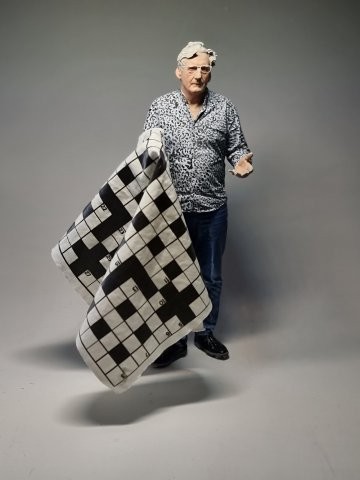
This 3D portrait attempts to capture Astle in a characteristic pose: poised mid-thought, mid-word, perhaps mid-anagram. In one hand he gestures, as if delivering an explanation or teasing out a clue. Draped across the other arm is a billowing crossword grid, almost like a magician’s cloth or a philosopher’s scroll. It’s an image both whimsical and reverent, one that positions Astle as both entertainer and intellectual—a man whose craft is serious, but never solemn.
Beyond the grid, David Astle’s reach is broad. Viewers of SBS’s Letters and Numbers know him as the resident word guru, unfurling etymologies and decoding obscure constructions with the joy of a child and the insight of a scholar. His books—including Rewording the Brain, Cluetopia, and Riddledom—are as much meditations on human thought and curiosity as they are celebrations of puzzles. His writing invites us to linger in the slipperiness of language, to marvel at its architecture, and to consider the mental muscles that flex when we tangle with ambiguity and logic.
Indeed, Astle’s legacy is more than entertainment. It sits at the very core of what it means to think. In a time when cognitive decline looms large in public consciousness, puzzles—particularly crosswords—have emerged as potent tools for keeping the mind limber. Numerous studies support the link between mentally stimulating activities and reduced risk of dementia, and cryptic crosswords in particular challenge reasoning, memory, and lateral thinking. These are games, yes, but they are also rigorous workouts for the brain’s executive functions: problem-solving, pattern recognition, and cognitive flexibility.
Astle, knowingly or not, has become part of that quiet resistance against mental decay. His clues—layered, elegant, sometimes maddening—are not just tests of vocabulary but challenges to our capacity to shift perspective, hold multiple interpretations, and find joy in the twist of logic. And perhaps that’s the deeper reason he holds such a unique place in our public life: in an anxious world, Astle’s puzzles offer not just escape, but engagement.
This sculptural tribute, with its playfulness and poise, adds a new dimension—literally and figuratively—to this public figure. The model suggests a man at ease in complexity, draped in his craft, part showman, part sage. It’s a fitting portrait for someone who, every day, helps us see language anew.
In the folds of that crossword blanket, in the raised eyebrow of a cryptic clue, and now in resin and pigment, David Astle continues to remind us that words matter—and that the best puzzles aren’t just games, but invitations to think, to play, and to remember who we are.
David Adtle - Wordsmith
David Astle: The Puzzle-Master Holding Language to the Light
In an era saturated with noise, distraction, and digital brevity, David Astle stands as a quiet, persistent force championing the richness of words. Best known to many Australians as the cryptic crossword compiler for The Sydney Morning Herald and The Age, Astle has long been the nation’s high priest of wordplay. But to limit him to the confines of a newspaper column would be to overlook a career that spans writing, performance, broadcasting, and teaching. Astle is not merely a puzzlemaker—he is a cultural figure engaged in preserving and reinvigorating our relationship with language.
This 3D portrait attempts to capture Astle in a characteristic pose: poised mid-thought, mid-word, perhaps mid-anagram. In one hand he gestures, as if delivering an explanation or teasing out a clue. Draped across the other arm is a billowing crossword grid, almost like a magician’s cloth or a philosopher’s scroll. It’s an image both whimsical and reverent, one that positions Astle as both entertainer and intellectual—a man whose craft is serious, but never solemn.
Beyond the grid, David Astle’s reach is broad. Viewers of SBS’s Letters and Numbers know him as the resident word guru, unfurling etymologies and decoding obscure constructions with the joy of a child and the insight of a scholar. His books—including Rewording the Brain, Cluetopia, and Riddledom—are as much meditations on human thought and curiosity as they are celebrations of puzzles. His writing invites us to linger in the slipperiness of language, to marvel at its architecture, and to consider the mental muscles that flex when we tangle with ambiguity and logic.
Indeed, Astle’s legacy is more than entertainment. It sits at the very core of what it means to think. In a time when cognitive decline looms large in public consciousness, puzzles—particularly crosswords—have emerged as potent tools for keeping the mind limber. Numerous studies support the link between mentally stimulating activities and reduced risk of dementia, and cryptic crosswords in particular challenge reasoning, memory, and lateral thinking. These are games, yes, but they are also rigorous workouts for the brain’s executive functions: problem-solving, pattern recognition, and cognitive flexibility.
Astle, knowingly or not, has become part of that quiet resistance against mental decay. His clues—layered, elegant, sometimes maddening—are not just tests of vocabulary but challenges to our capacity to shift perspective, hold multiple interpretations, and find joy in the twist of logic. And perhaps that’s the deeper reason he holds such a unique place in our public life: in an anxious world, Astle’s puzzles offer not just escape, but engagement.
This sculptural tribute, with its playfulness and poise, adds a new dimension—literally and figuratively—to this public figure. The model suggests a man at ease in complexity, draped in his craft, part showman, part sage. It’s a fitting portrait for someone who, every day, helps us see language anew.
In the folds of that crossword blanket, in the raised eyebrow of a cryptic clue, and now in resin and pigment, David Astle continues to remind us that words matter—and that the best puzzles aren’t just games, but invitations to think, to play, and to remember who we are.