


Harold Ross (1892–1951)
Founder of The New Yorker
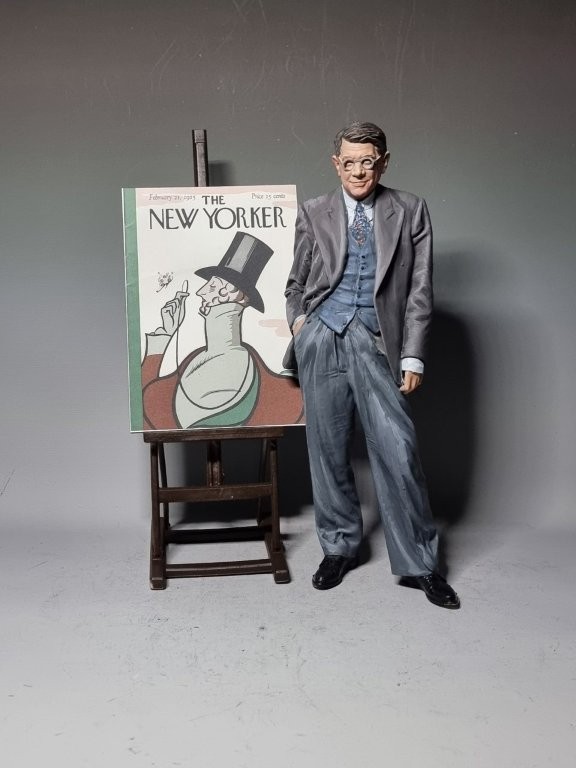
This 3D portrait depicts Harold Wallace Ross, the founding editor of The New Yorker, one of the most influential and enduring magazines of the twentieth century. Established in 1925, The New Yorker was Ross’s singular creation—an editorial experiment that would come to define a particular tone of wit, intelligence, and cultural refinement associated with New York City itself.
Ross was not, in the conventional sense, a literary man. He had little formal education and began his career as a journalist in the rough-and-tumble world of American newspapers, working his way through a series of publications across the country. During the First World War, he served as editor of Stars and Stripes, the newspaper for American troops in Europe. It was there that he began to develop a reputation for editorial discipline and clarity—traits that would later become central to his legacy.
The idea for The New Yorker emerged in the early 1920s, when Ross, together with his wife Jane Grant and a circle of writers and critics, sought to create a magazine that was distinctly different from the mass-market publications of the time. It would not be provincial, sentimental, or broadly populist. Instead, it would be urbane, precise, and sophisticated—aimed at a readership that understood nuance and valued intelligence.
From the outset, Ross imposed extraordinarily high editorial standards. He was known for his famously blunt marginal queries—most notably “Who he?”—a demand for clarity whenever a reference was deemed obscure or insufficiently explained. This insistence on precision became a hallmark of the magazine, ensuring that its writing remained accessible without ever being simplistic.
Under Ross’s leadership, The New Yorker became a platform for some of the most important writers of the twentieth century, including E. B. White, Dorothy Parker, James Thurber, and later John Updike and J. D. Salinger. It was also a magazine that gave equal weight to journalism, fiction, humour, and visual art—treating each with seriousness and care.
The visual identity of The New Yorker is inseparable from its founding moment. The figure of Eustace Tilley, the monocled dandy who appeared on the cover of the first issue, became an enduring emblem of the magazine. Designed by artist Rea Irvin, Tilley was both a symbol and a subtle satire—representing a certain kind of cultivated observer, detached yet attentive, refined yet faintly absurd. This balance between seriousness and wit lay at the heart of Ross’s editorial vision.
The inclusion of New Yorker covers in this portrait reflects Ross’s deep understanding of the relationship between image and text. Unlike many publications of the period, The New Yorker treated its covers not as advertisements but as works of art—often enigmatic, occasionally humorous, and always carefully considered. Over time, these covers have become a significant cultural archive in their own right, documenting shifts in society, politics, and taste.
Ross himself was an unlikely embodiment of the world he created. He was known to be direct, even brusque, and often insecure about his own intellectual standing. Yet it was precisely this awareness that drove his commitment to clarity and quality. He surrounded himself with writers and artists of exceptional ability, and he demanded from them—and from himself—a level of rigour that ensured the magazine’s lasting influence.
In this portrait, Ross is shown not as a commanding figure, but as a man slightly withdrawn, hands in his pockets, absorbed in thought. The stance reflects his role not as a performer but as an editor—someone who shaped the work of others, often invisibly, but with decisive impact. The accompanying cover imagery serves as both context and counterpoint: the public face of a magazine that was, at its core, the product of one man’s exacting standards.
Harold Ross’s achievement lies not simply in founding a successful publication, but in establishing a model of editorial integrity that continues to resonate. Nearly a century after its first issue, The New Yorker remains a benchmark for thoughtful journalism, literary excellence, and visual sophistication. That continuity is a testament to Ross’s original vision—one grounded in the belief that readers should never be underestimated, and that quality, once established, must be maintained without compromise.
Harold Ross - Founder of New Yorker Magazine
Harold Ross (1892–1951)
Founder of The New Yorker
This 3D portrait depicts Harold Wallace Ross, the founding editor of The New Yorker, one of the most influential and enduring magazines of the twentieth century. Established in 1925, The New Yorker was Ross’s singular creation—an editorial experiment that would come to define a particular tone of wit, intelligence, and cultural refinement associated with New York City itself.
Ross was not, in the conventional sense, a literary man. He had little formal education and began his career as a journalist in the rough-and-tumble world of American newspapers, working his way through a series of publications across the country. During the First World War, he served as editor of Stars and Stripes, the newspaper for American troops in Europe. It was there that he began to develop a reputation for editorial discipline and clarity—traits that would later become central to his legacy.
The idea for The New Yorker emerged in the early 1920s, when Ross, together with his wife Jane Grant and a circle of writers and critics, sought to create a magazine that was distinctly different from the mass-market publications of the time. It would not be provincial, sentimental, or broadly populist. Instead, it would be urbane, precise, and sophisticated—aimed at a readership that understood nuance and valued intelligence.
From the outset, Ross imposed extraordinarily high editorial standards. He was known for his famously blunt marginal queries—most notably “Who he?”—a demand for clarity whenever a reference was deemed obscure or insufficiently explained. This insistence on precision became a hallmark of the magazine, ensuring that its writing remained accessible without ever being simplistic.
Under Ross’s leadership, The New Yorker became a platform for some of the most important writers of the twentieth century, including E. B. White, Dorothy Parker, James Thurber, and later John Updike and J. D. Salinger. It was also a magazine that gave equal weight to journalism, fiction, humour, and visual art—treating each with seriousness and care.
The visual identity of The New Yorker is inseparable from its founding moment. The figure of Eustace Tilley, the monocled dandy who appeared on the cover of the first issue, became an enduring emblem of the magazine. Designed by artist Rea Irvin, Tilley was both a symbol and a subtle satire—representing a certain kind of cultivated observer, detached yet attentive, refined yet faintly absurd. This balance between seriousness and wit lay at the heart of Ross’s editorial vision.
The inclusion of New Yorker covers in this portrait reflects Ross’s deep understanding of the relationship between image and text. Unlike many publications of the period, The New Yorker treated its covers not as advertisements but as works of art—often enigmatic, occasionally humorous, and always carefully considered. Over time, these covers have become a significant cultural archive in their own right, documenting shifts in society, politics, and taste.
Ross himself was an unlikely embodiment of the world he created. He was known to be direct, even brusque, and often insecure about his own intellectual standing. Yet it was precisely this awareness that drove his commitment to clarity and quality. He surrounded himself with writers and artists of exceptional ability, and he demanded from them—and from himself—a level of rigour that ensured the magazine’s lasting influence.
In this portrait, Ross is shown not as a commanding figure, but as a man slightly withdrawn, hands in his pockets, absorbed in thought. The stance reflects his role not as a performer but as an editor—someone who shaped the work of others, often invisibly, but with decisive impact. The accompanying cover imagery serves as both context and counterpoint: the public face of a magazine that was, at its core, the product of one man’s exacting standards.
Harold Ross’s achievement lies not simply in founding a successful publication, but in establishing a model of editorial integrity that continues to resonate. Nearly a century after its first issue, The New Yorker remains a benchmark for thoughtful journalism, literary excellence, and visual sophistication. That continuity is a testament to Ross’s original vision—one grounded in the belief that readers should never be underestimated, and that quality, once established, must be maintained without compromise.