


"Maurice Sendak" - 3D Portrait
Maurice Sendak’s Where the Wild Things Are occupied a special place in my childhood, not only for me, but particularly for my younger brother, who was four years younger than me and was given the book sometime in the early 1960s, not long after its publication. Like many children of that era, we encountered Sendak’s world before we understood anything about literary criticism, psychology, or the cultural debates that surrounded the book. We simply responded instinctively to its emotional truth: the mixture of fear, loneliness, imagination, rebellion, and comfort that lies at the centre of childhood itself.
This sculpture forms part of a larger series of portrait works exploring artists, writers, musicians, and cultural figures whose work has remained personally important to me over many decades. Rather than attempting to create straightforward historical likenesses, I am increasingly interested in constructing small theatrical worlds around these individuals — works that function as memory pieces as much as portraits.
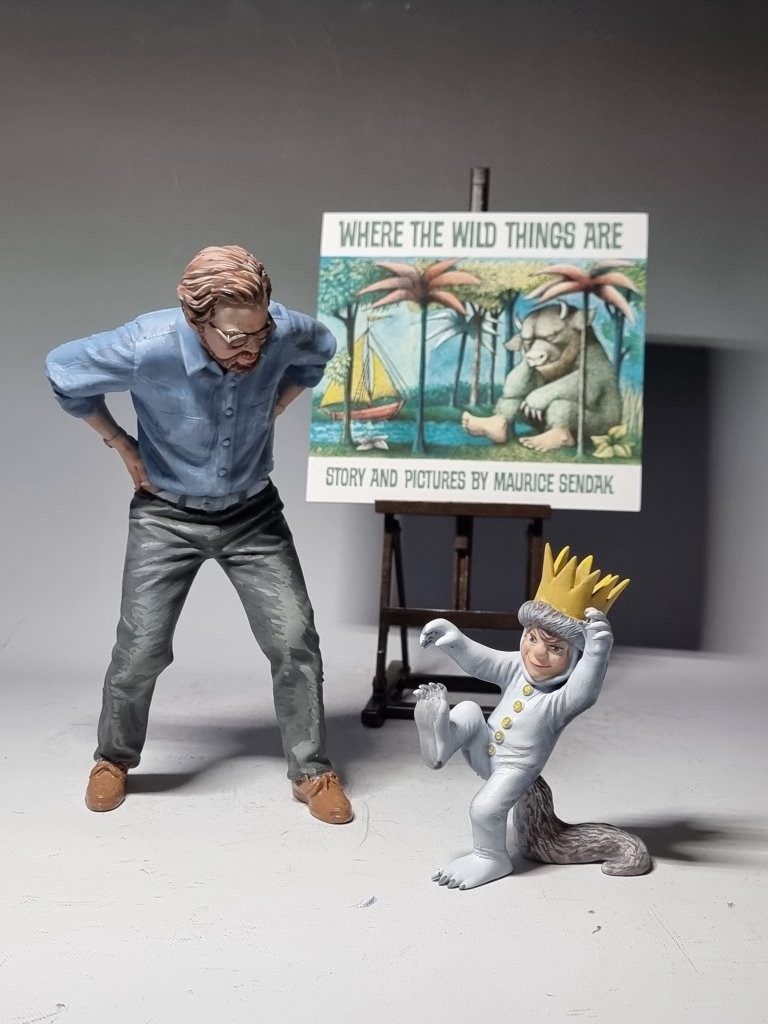
For this reason, I chose not to depict Maurice Sendak as the elderly man familiar from later interviews and documentaries. Instead, I imagined him as a younger artist, standing at the threshold of the extraordinary moment when Where the Wild Things Are first entered the world. The figure leans towards the easel almost as though observing his own imagination becoming real, while Max, in his wolf suit and crown, steps physically out from the book itself.
In many ways, the sculpture is not simply about Maurice Sendak. It is about the act of artistic invention and the enduring emotional force of childhood imagery. The wild things remain alive because they are tied to memory — both personal memory and collective memory. Entire generations of children carried those images with them into adulthood.
Some years ago, I watched a documentary filmed late in Sendak’s life, when he was already an elderly man. He spoke candidly about the enormous impact Where the Wild Things Are had upon his career and how suddenly it transformed his life. Yet he also recalled the hostility the book received from some authority figures at the time. One prominent psychiatrist publicly condemned the work and declared that he would never allow a child even to be in the same room as the book. Sendak recounted meeting the man many years later while both were receiving honorary doctorates. Upon being introduced, the psychiatrist bluntly told him, “I hate your books.”
What fascinated me about this story was not merely the cruelty or absurdity of the criticism, but the deeper irony it revealed. Works of imagination that speak honestly to children often unsettle adults who seek complete order, certainty, or emotional control. Where the Wild Things Are acknowledged something that many children instinctively recognise — that anger, fear, fantasy, and wildness are natural parts of emotional life. Sendak did not sentimentalise childhood. He respected it.
The psychiatrist later took his own life, a tragic fact that Sendak mentioned without triumph or bitterness. Hearing the story now, many decades after the book’s publication, one is reminded how strangely temporary critical judgement can be. The fearful condemnation faded into history, while the book itself endured and became one of the most beloved works of children’s literature ever produced.
That tension between imagination and control, innocence and anxiety, memory and criticism, became an important emotional undercurrent in this sculpture.
The looser style of painting used in this work was also intentional. Rather than pursuing extreme detail or photographic finish, I wanted the figures to retain something of the softness and suggestiveness of memory itself. The visible brushwork allows the piece to feel less like a literal reconstruction and more like a remembered scene — part theatre, part recollection, part tribute.
Ultimately, this sculpture is both a portrait of Maurice Sendak and a reflection upon the imaginative world he gave to so many children, including my own family. Like the book itself, it attempts to occupy that curious territory between dream and reality, where childhood memories continue to live long after childhood has passed.
Maurice Sendak
"Maurice Sendak" - 3D Portrait
Maurice Sendak’s Where the Wild Things Are occupied a special place in my childhood, not only for me, but particularly for my younger brother, who was four years younger than me and was given the book sometime in the early 1960s, not long after its publication. Like many children of that era, we encountered Sendak’s world before we understood anything about literary criticism, psychology, or the cultural debates that surrounded the book. We simply responded instinctively to its emotional truth: the mixture of fear, loneliness, imagination, rebellion, and comfort that lies at the centre of childhood itself.
This sculpture forms part of a larger series of portrait works exploring artists, writers, musicians, and cultural figures whose work has remained personally important to me over many decades. Rather than attempting to create straightforward historical likenesses, I am increasingly interested in constructing small theatrical worlds around these individuals — works that function as memory pieces as much as portraits.
For this reason, I chose not to depict Maurice Sendak as the elderly man familiar from later interviews and documentaries. Instead, I imagined him as a younger artist, standing at the threshold of the extraordinary moment when Where the Wild Things Are first entered the world. The figure leans towards the easel almost as though observing his own imagination becoming real, while Max, in his wolf suit and crown, steps physically out from the book itself.
In many ways, the sculpture is not simply about Maurice Sendak. It is about the act of artistic invention and the enduring emotional force of childhood imagery. The wild things remain alive because they are tied to memory — both personal memory and collective memory. Entire generations of children carried those images with them into adulthood.
Some years ago, I watched a documentary filmed late in Sendak’s life, when he was already an elderly man. He spoke candidly about the enormous impact Where the Wild Things Are had upon his career and how suddenly it transformed his life. Yet he also recalled the hostility the book received from some authority figures at the time. One prominent psychiatrist publicly condemned the work and declared that he would never allow a child even to be in the same room as the book. Sendak recounted meeting the man many years later while both were receiving honorary doctorates. Upon being introduced, the psychiatrist bluntly told him, “I hate your books.”
What fascinated me about this story was not merely the cruelty or absurdity of the criticism, but the deeper irony it revealed. Works of imagination that speak honestly to children often unsettle adults who seek complete order, certainty, or emotional control. Where the Wild Things Are acknowledged something that many children instinctively recognise — that anger, fear, fantasy, and wildness are natural parts of emotional life. Sendak did not sentimentalise childhood. He respected it.
The psychiatrist later took his own life, a tragic fact that Sendak mentioned without triumph or bitterness. Hearing the story now, many decades after the book’s publication, one is reminded how strangely temporary critical judgement can be. The fearful condemnation faded into history, while the book itself endured and became one of the most beloved works of children’s literature ever produced.
That tension between imagination and control, innocence and anxiety, memory and criticism, became an important emotional undercurrent in this sculpture.
The looser style of painting used in this work was also intentional. Rather than pursuing extreme detail or photographic finish, I wanted the figures to retain something of the softness and suggestiveness of memory itself. The visible brushwork allows the piece to feel less like a literal reconstruction and more like a remembered scene — part theatre, part recollection, part tribute.
Ultimately, this sculpture is both a portrait of Maurice Sendak and a reflection upon the imaginative world he gave to so many children, including my own family. Like the book itself, it attempts to occupy that curious territory between dream and reality, where childhood memories continue to live long after childhood has passed.