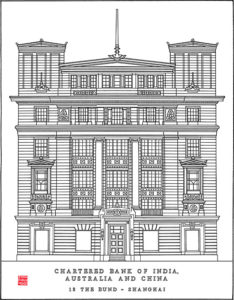
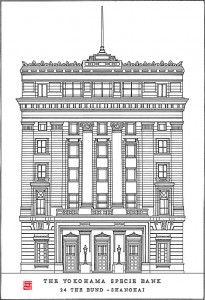
HSBC Bank Shanghai (former)
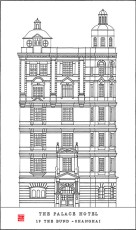
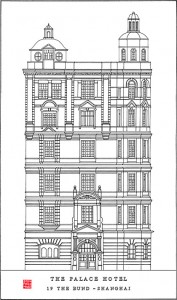
The Palace Hotel - Shanghai
Fairmont Peace Hotel
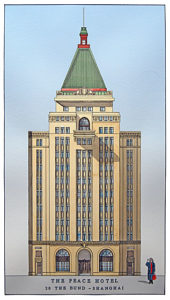
The Peace Hotel (Chinese: 和平饭店) is a hotel on The Bund in Shanghai, China which overlooks the Huangpu River. The hotel today operates as two separate businesses. The North Building, built as Sassoon House, originally housed the Cathay Hotel and is today the Fairmont Peace Hotel run by Fairmont Hotel and Resorts of Canada. The South Building was built as the Palace Hotel and is today the Swatch Art Peace Hotel . The two buildings both face the Bund, but are divided by the famous Nanjing Road, arguably the busiest street in Shanghai.
North Building
The larger North Building at Number 20, The Bund, is called Sassoon House. It was built by Sir Victor Sassoon, of the famous Sassoon family who dominated Shanghai business and real estate in the early 20th century. He was a British Sephardic Jew of Iraqi origin, and his family had extensive business in Hong Kong, Shanghai, and Calcutta. Sassoon House was the first high rise building built by Victor Sassoon. It was designed by P & T Architects Limited (Palmer and Turner), with a reinforced concrete structure. It occupied 4617 square metres, with a floor space of 36,317 square metres. Construction began in 1926 and completed in 1929. The building is ten storeys in height, partially thirteen storeys, and with a basement. The total height is 77 metres. From external design to interior decor, a consistent design scheme was followed. The building featured extensive use of straight lines in the exterior, with decorative patterns at pediments and eaves. Most of the building features granite facing, with the ninth floor and the roof surfaced with terracotta. The eastern facade (facing the Huangpu River and the Bund) features a pyramidal roof with steep sides and a height of about 10 metres. The pyramid is faced with copper (which is now green).
The building features an "A" shaped cross section. Before 1949, the ground floor space facing the Bund was leased to two banks. This space later became the Shanghai branch of Citibank in the 1980s. The rest of the ground floor featured a shopping arcade. Two main walkways crossed in the centre at an octagonal hall. The first to third floor were leased as offices. Sassoon's companies and subsidiaries had their offices in the fourth floor. The fifth to seventh floors housed the Cathay Hotel, with rooms decorated in exotic international themes. The eighth floor housed the main bar, a ball room, and a Chinese restaurant. The ninth floor is a night club and a small dining hall. The tenth floor was Victor Sassoon's private apartments. Within the pyramidal roof was the large dining hall.
Before 1949, the Cathay Hotel was regarded as the most prestigious hotel in Shanghai. Most international envoys visiting Shanghai would stay in the hotel. After the Communist takeover in 1949, some of the offices were used by the Municipal Finance Committee. In 1952 the building was taken over by the Municipal Government. In 1956 it resumed trading as a hotel under the name "Peace Hotel". In 1992 the Peace Hotel was listed as one of the famous hotels of the world by the World Hotel Association. It has become particularly renowned for its Jazz Band and its roof terrace restaurant, overlooking the now booming district of Pudong across the Huangpu. In 2007, the hotel closed for a 3 year renovation and the North Building reopened in 2010 as the Fairmont Peace Hotel Shanghai. The hotel offers 269 deluxe guestrooms and suites with a selection of eight restaurants and lounges. A low-rise extension has been added to the rear of the hotel, housing guestrooms as well as a sky-lit swimming pool and spa. The renovation also preserved many elements of its historical 1920's and 1930's past.
South Building
Separated from the North Building by busy Nanjing Road, the South Building was constructed as the Palace Hotel in 1908 on the site of the Central Hotel, which had been founded on the same site in the 1850s. When built, the six story hotel was the tallest building on Nanjing Road. The hotel occupies 2125 square meters, with a floor space of 11607 metres. It has a brick veneer structure, with six stories reaching 30 meters in height. The exterior adopts a Renaissance style. The hotel has around 120 guest rooms. It also featured two elevators, the first building to do so in Shanghai.
In 1909, the first meeting of the World Anti-Narcotics League was held here. In 1911, after the success of the Xinhai Revolution, Sun Yat-sen stayed at the hotel and advocated commitment to the revolutionary cause. During World War II, the building was occupied by the Japanese army. In 1947 it was purchased by a Chinese company. After the revolution in 1949 it continued trading until 1952, when it was confiscated and used by the Municipal Construction Department. In 1965 it resumed trading as a hotel as a wing of the Peace Hotel.
Similar to its counterpart to the north, the South Building was renovated in preparation for the 2010 World Expo. It emerged as the Swatch Art Peace Hotel. It plays host to gifted artists from around the world who live and work for a limited time in apartment/workshops. The heritage facade and public rooms of the building have been restored to their original splendor, while the building also features boutiques, a Swatch showroom and restaurants.
This is a hotel owned by the YTL Hotels Corporation of Malaysia
Reading: Private Lives, a play by Noel Coward written in the Cathay Hotel
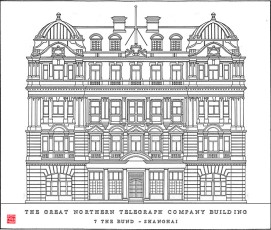
Great Northern Telegraph Building - Shanghai
The Great Northern Telegraph Corporation Building (No. 7, The Bund), housed The Great Northern Telegraph Company. Site of the first telephone switch in Shanghai in 1882.
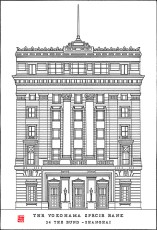
Yokohama Specie Bank - Shanghai
No. 24 Yokohama Specie Bank Building
Yokohama Specie Bank Building (No. 24, The Bund) housed the Japanese Yokohama Specie Bank.
The Yokohama Specie Bank Building, now Shanghai Textile Holding Corporation, is a seven-floor building in the Chinese city of Shanghai and was completed in the 1920s. It was built by architects P & T Architects & Engineers Ltd. (Palmer and Turner)
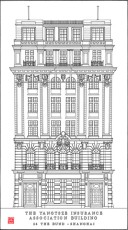
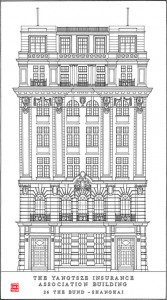
The Yangste Insurance Association Building - Shanghai
No. 26 Yangtsze Insurance Association Building
No. 26 Yangtsze Insurance Association Building The Bund Today houses the a Shanghai branch of the Agricultural Bank of China
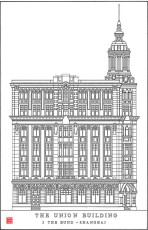
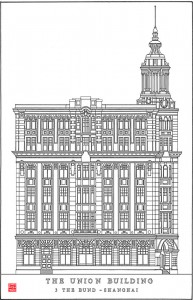
The Union Building - Shanghai
No. 3 The Union Building is a building on the Bund in Shanghai, China. It is was formerly No. 4.
Completed in 1916, the building was used by a number of insurance companies. The six-storey building was the first work in Shanghai of P&T Architects and Surveyors (Palmer & Turner), and was the first building in Shanghai to use a steel structure. The building occupied 2241 square metres, with a floor area of 13760 square metres. Because it had a narrow frontage onto the Bund, the main door was located on the adjacent Guangdong Road.
The building is in Neo-Renaissance style with a symmetrical facade, but with some Baroque style details. The roof features a domed corner pavilion.
In 1937, the Japanese Imperial Army threatened Shanghai. Being unable to indemnify war damages, the insurance companies had their assets frozen. The Union Bank then purchased building. In 1949 the Union Bank evacuated from Shanghai in the wake of the Communist takeover. From 1953 the building was used by the Shanghai Civil Architecture and Design Institute. In 1997 a private equity fund from Singapore purchased the building, and in 2004 converted it to a 'high-class' shopping centre, called 'Three on the Bund'.
Baroque style details
According to the Oxford English Dictionary, the word baroque is derived from the Portuguese word "barroco", Spanish "barroco", or French "baroque", all of which refer to a "rough or imperfect pearl", though whether it entered those languages via Latin, Arabic, or some other source is uncertain.[3] A century ago, the Encyclopedia Britanica 11th edition, thought the term was derived from the Spanish barrueco, a large, irregularly-shaped pearl, and it was for a time confined to the craft of the jeweller. Others derive it from the mnemonic term "Baroco" denoting, in logical Scholastica, a supposedly laboured form of syllogism.[5] In informal usage, the word baroque can simply mean that something is "elaborate", with many details, without reference to the Baroque styles of the seventeenth and eighteenth centuries.
The word "Baroque", like most periodic or stylistic designations, was invented by later critics rather than practitioners of the arts in the 17th and early 18th centuries. It is a French transliteration of the Portuguese phrase "pérola barroca", which means "irregular pearl", and natural pearls that deviate from the usual, regular forms so they do not have an axis of rotation are known as "baroque pearls".
The term "Baroque" was initially used with a derogatory meaning, to underline the excesses of its emphasis. In particular, the term was used to describe its eccentric redundancy and noisy abundance of details, which sharply contrasted the clear and sober rationality of the Renaissance. Although it was long thought that the word as a critical term was first applied to architecture, in fact it appears earlier in reference to music, in an anonymous, satirical review of the première in October 1733 of Rameau's Hippolyte et Aricie, printed in the Mercure de France in May 1734. The critic implied that the novelty in this opera was "du barocque", complaining that the music lacked coherent melody, was filled with unremitting dissonances, constantly changed key and meter, and speedily ran through every compositional device.
Modern usage
In modern usage, the term "Baroque" may still be used, usually pejoratively, describing works of art, craft, or design that are thought to have excessive ornamentation or complexity of line, or, as a synonym for "Byzantine", to describe literature, computer software, contracts, or laws that are thought to be excessively complex, indirect, or obscure in language, to the extent of concealing or confusing their meaning.
The word was first rehabilitated by the Swiss-born art historian, Heinrich Wölfflin (1864–1945) in his Renaissance und Barock (1888); Wölfflin identified the Baroque as "movement imported into mass," an art antithetic to Renaissance art. He did not make the distinctions between Mannerism and Baroque that modern writers do, and he ignored the later phase, the academic Baroque that lasted into the 18th century. Writers in French and English did not begin to treat Baroque as a respectable study until Wölfflin's influence had made German scholarship pre-eminent.
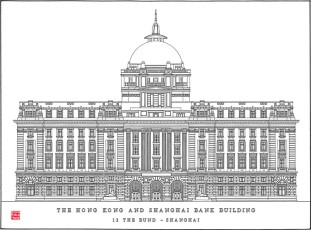
HSBC Bank - Shanghai
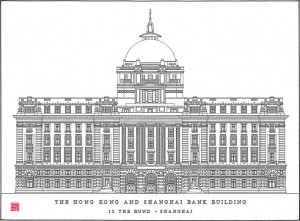
The HSBC Building is a six-floor neo-classical building in the Bund area of Shanghai, China. It was the headquarters of the Shanghai branch of The Hongkong and Shanghai Banking Corporation from 1923 to 1955. The building is situated at number 12, the Bund. It is also known as the Municipal Government Building. Currently it houses the Shanghai Pudong Development Bank. Construction began on 5 May 1921, and completed in 23 June 1923. This building was built in the style of neo-classicism in China. It was designed by the British architecture firm, Palmer & Turner Architects and Surveyors.
The HSBC Building has been called "the most luxurious building from the Suez Canal to the Bering Strait".[1] The building has a floor area of 23,415 m², and was, at the time, the largest bank building in the Far East, and second largest in the world, after the Bank of Scotland building in Edinburgh.
The building exterior adopted a strict neo-classicist design, with a tripartite vertical and horizontal division. In the centre is a dome, the base decorated with a triangular structure in imitation of Greek temples. Below that are six Ionic columns penetrating from the second to the fourth storey. The main structure is five storeys, the central section seven storeys, with one and a half storey for the basement. The main structure has a steel lattice with brick filling, and a granite exterior.
The interior was luxuriously decorated, using materials such as marble and monel. The whole building was fitted with heating and air-conditioning. The main trading hall has four columns hewn from whole blocks of marble, which was at the time unique in Asia.
Behind the main building is a subsidiary building which houses bank offices, safes, and vaults.
History
On 4 March 1865, HSBC opened its Shanghai branch on the ground floor of the Central Hotel (now Peace Hotel) on the corner of the Bund with Nanjing Road.
By 1874, HSBC's business had grown so much that the existing premises was becoming cramped. The bank then purchased the Foreign Club, a three storey building at number 12, the Bund, south of the Customs House, for 60,000 taels of silver.
In 1912, the bank made further acquisitions at number 10 and number 11, the Bund, and began construction of the new building. Construction began on 5 May 1921, with the dome capped off on 23 June 1923. According to contemporary press reports, at the time of construction the bank hired feng shui masters to select the time and direction of the first excavation. In accordance with Chinese tradition, coins from around the world were buried in the foundations. Specially minted coins were placed in dark recesses of the building to ward off spirits. The construction took 25 months, and the completed building occupied 1.3 hectares, with an area of 23,415 m². The architect's firm, Palmer & Turner, also designed numerous other buildings on the Bund including the Yokohama Specie Building, Yangtze Insurance Building, and Bank of China Building.
During the Second World War, the HSBC building was occupied by the Japanese Yokohama Specie Bank. HSBC moved back at the end of the war. The Communists took over Shanghai in 1949. HSBC continued to operate in the relative freedom of the early years of the People's Republic. However, in 1955 the political situation led the bank to scale down its operations in Shanghai. The building was handed over to the government, and HSBC rented separate offices nearby. Later in that year, the Shanghai Municipal Government moved into the building. The building's name was changed to "The People's Government of the Municipality of Shanghai Building", or "Municipal Government Building" for short. The subsidiary building housed the Municipal Archives from 1956.
In 1990, the Municipal Government began moving civic institutions out of the Bund in favour of commercial institutions. HSBC made contact with the Municipal Government on repurchasing the building, but negotiations failed due to price reasons.
In 1995, the Municipal Government moved out of the building, and the Shanghai Pudong Development Bank obtained the lease to the building. During renovations, spectacular murals were uncovered in the building. HSBC's Chinese office is currently headquartered at HSBC Building, Shanghai IFC.
The bank commissioned two bronze lions from the United Kingdom at the time of construction, to be placed outside the front doors flanking the entrance staircase. They were cast by J W Singer & Sons in the English town of Frome, to a design by Henry Poole RA,.[2] One of the lions is depicted roaring, to symbolise protection, the other is calm, and symbolises security. Affectionately nicknamed Stephen and Stitt, (after A G Stephen, once Manager Shanghai and the driving force behind the construction of the building, and by then the Bank's Chief Manager; and G H Stitt, Stephen's successor as Manager Shanghai, and the incumbent when the building was opened on 23 June 1923). An in-joke: Stephen's was said to be the louder character, Stitt the quieter man.
These lions were the inspiration for a second and much larger pair to a completely new design by Shanghai-based British Sculptor W W Wagstaffe that were commissioned for the Bank's new Headquarters in Hong Kong, opened in 1935. This second pair of lions was cast in Shanghai.[3]
During the wartime occupation of Shanghai, the lions were removed by the Japanese to be melted down for their valuable bronze, but they escaped this fate and were restored after the end of the war. They were removed once again in 1966, during the Cultural Revolution. The Shanghai Artefact Administration Board stored the lions in the warehouse of the Shanghai Comedy Troupe. In 1980 they were handed over to the Shanghai Museum where they are on display today. In 1997, when the Pudong Development Bank moved into the building, replicas were made and placed in front of the building.
Dome mosaics
Photo: Wiki The Hongkong and Shanghai Banking Corporation building's ceiling, a delicate mosaic.
Near the ceiling of the octagonal entrance hall of the bank building were originally eight mosaic murals. The dome was decorated with frescos depicting the twelve signs of the zodiac, as well personifications of the Sun and Moon. An enterprising architect had the mosaics covered over in stucco and paint to save them from destruction during the Cultural revolution. Red Guards intent on the mosaics' destruction initially wanted to chip away the mosaics' tiles. The architect suggested it would take less work to just cover them up, knowing full well it would preserve the artwork. In 1997, renovations uncovered them. The Pudong Development Bank then funded the restoration, but changed the HSBC emblems in the paintings to the Pudong Development Bank emblem.
The eight murals depicted eight cities in which HSBC had branches: Shanghai, Hong Kong, Tokyo, London, New York, Bangkok, Paris, and Calcutta. Each fresco featured a principal mythological figure, supported by personifications of local rivers and the city, with city scenery in the background.
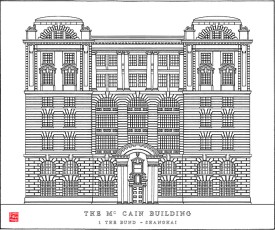
Mc Bain Building - Shanghai
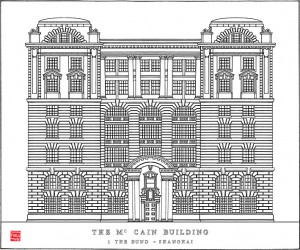
The six-storey Asia Building (simplified Chinese: 上海亚细亚大楼; traditional Chinese: 上海亞細亞大樓; pinyin: Shànghǎi Yàxìyà Dàlóu), also known as Mc Bain or Asiatic Petroleum building, is on the Bund in the Chinese city of Shanghai. It was built in 1916 for Royal Dutch Shell's Asiatic Petroluem division and later housed the Shanghai Metallurgical Designing & Research Institute.
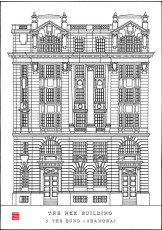
NKK Building - Shanghai
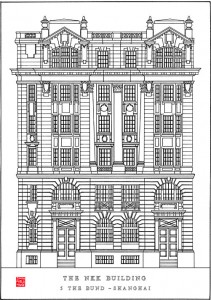
No. 5 Nissin Building The Bund housed a Japanese shipping company.
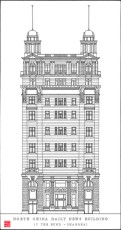
North China Daily News Building - Shanghai
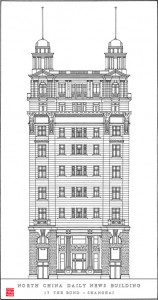
No. 17 The North China Daily News Building
North China Daily News Building (Chinese: 字林大樓; pinyin: Zìlín Dàlóu) is a historical Neo-Renaissance-style office building on the Bund in Shanghai, China. It is located at Number 17, East Zhongshan No.1 Road and currently houses the offices of the American International Assurance (AIA) and is thus often called the AIA Building (友邦大廈 Yǒubāng Dàshà). At the time of its opening in 1924, it was the tallest building in Shanghai.
History
Construction began in 1921 on a building for the North China Daily News, an English-language newspaper based in Shanghai. The structure, built by Lester, Johnson & Morriss (德和洋行 Déhé Yángháng), a firm co-founded by Gordon Morriss (馬立師 Mǎ Lìshī), brother of the newspaper's owner Henry E. Morriss (馬立斯 Mǎ Lìsī), was completed in June 1923 and dedicated on 16 February 1924. In addition to the offices of the newspaper on several floors, the building also housed American Asiatic Underwriters an insurance agency founded by Cornelius Vander Starr and forerunner of the American International Group (AIG) from 1927.
During the Japanese occupation of Shanghai during the Second Sino-Japanese War (World War II), the building was home to the Tairiku Shimpō (大陸新報), a Japanese newspaper.
Following the victory of the Chinese Communist Party in the Chinese Civil War, the North China Daily News was closed in 1951 and the North China Daily News Building was seized by the People's Republic of China Shanghai municipal government.
In 1998, American International Assurance (AIA), a subsidiary of the American Asiatic Underwriters successor company, the American International Group, returned to the building.
Design
The North China Daily News Building is a reinforced concrete structure with granite outer walls with both Neoclassical and Renaissance stylings. The building contains 9043 m² and lies on a 1043-m² plot of land.
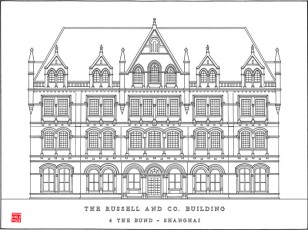
Russell Co Building - Shanghai
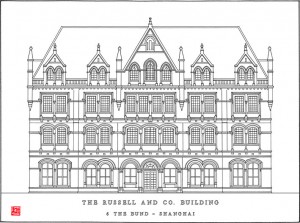
No. 6 Russel and Co. Building The Bund now houses the China Shipping Merchant Company.
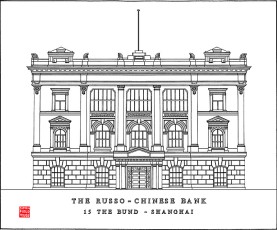
Russo Chinese Bank - Shanghai
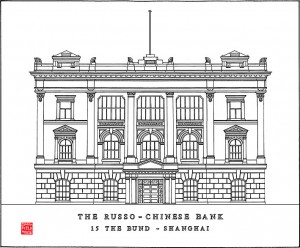
No. 15 Russo-Chinese Bank Building now the Shanghai Foreign Exchange
The St. Petersburg Russo-Asiatic Bank. Renamed Central Building in 1928. It was designed by German architects Becker & Baedecker and built between 1901-1905 of brick and concrete composite structure. It is the earliest building equipped with tile facing, lifts, and sanitary facilities in Shanghai.
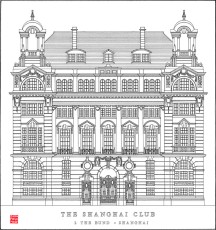
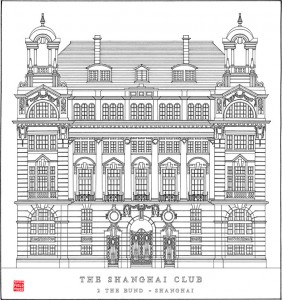
Shanghai Club
No 2 The Bund
The Shanghai Club Building is a three-storey neo-classical building in Shanghai along The Bund. The club was originally named 'The Correspondent's Club'.
Structure
The Shanghai Club Building is a three-storey neo-classical building in Shanghai along The Bund. The club was originally named 'The Correspondent's Club'.
The original Shanghai Club was a three-storey red-brick building constructed the British in 1861. The club was rebuilt in 1905.[1]
The original Club was torn down and rebuilt in 1910 with reinforced concrete in a neo-classical design. The large first floor dining room had black and white marble flooring, while the entrance staircase used imported white Sicilian marble.
History
The club was a British men's club and was the most exclusive club in Shanghai during the heyday of the 1920s and 1930s. The membership fee was $125 and monthly dues were $9.
United States President Ulysses S. Grant was hosted there when he visited Shanghai in 1879.
The second-floor was famous for the "Long Bar." This was an unpolished mahogany, L-shaped bar that measured 110.7 feet by 39 feet. On one side of the bar was a smoking room and library, while on the other side was a billiards room. It was famous for being the world's longest bar at one time[1]. Noel Coward said, laying his cheek on it, that he could see the curvature of the earth.
There were also forty guest rooms on the second and third floors. It later became the Dongfeng Hotel, and even housed a KFC restaurant from 1990 to 1996.
This restored building as of October 2010 is the Waldorf Astoria Shanghai, a luxury hotel.
The old boys' club that controlled Shanghai ran it from the leather-and-whiskey soaked confines of the Shanghai Club on the Bund, where membership was restricted to white males of a certain class. Even the famous 34-metre Long Bar on the second floor was subject to a strict hierarchy: the prime Bund-facing end of the L-shaped mahogany bar was the territory of the taipans and bank manager, with the social scale falling as one moved down the length of the bar.The grand, neoclassical white marble building opened its doors in 1910 to reveal what would ultimately be Shanghai'smost luxurious, most exclusive club. A massive Italianate Grand Hall, with ceilings over 12 feet high, supported by enormous Ionic columns. The hall ended in a curving marble staircase, where twin elevators whisked members to the upper floors. Here, there were all the requisites of a proper gentleman's club: a smoking room and a library – reported to hold more volumes than the Shanghai Public Library – a billiards room, a dining room for long, boozy lunches and guest rooms on top two floors for resident members.
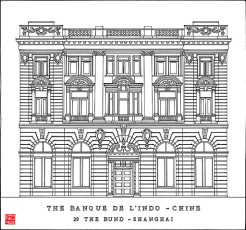
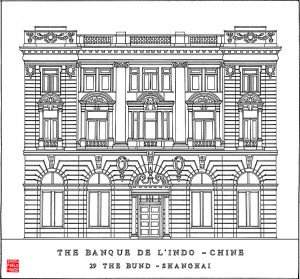
The Banque De Lindo Chine - Shanghai
No 29 - The Bund - Shanghai
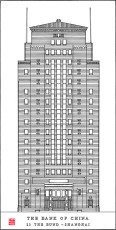
Bank of China - Shanghai
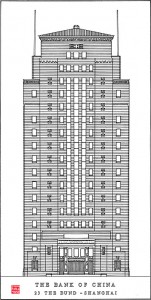
he Bank of China Building is a tower located at No. 23 on the Bund, in Shanghai, People's Republic of China. Previously the headquarters of the Bank of China, it now houses the Shanghai Branch of the Bank of China.
It was built on the site of the old German Club (c. 1907). It housed the headquarters of the Bank of China. The stunted appearance of the building is attributed to Victor Sassoon's insistence that no other building on the Bund could rise higher than his.
The Bank of China purchased land in Jinkee Road (now Dianchi Road) and Yuenmingyuen Road (now Yuanmingyuan Road) in 1930. From then on, the Shanghai branch would each year set aside RMB 500,000 from its surplus, as the construction fund. In April 1934, the board of directors decided to construct an 18-floor building, for the office administration and operation of the Head Office and the Shanghai Branch. The estimated basic construction cost was RMB 6 million.
A primary reason why the bank officials want to have the building in the Bund concession was according to Zhang Jia and Wang Ao, the then presidents of the Bank of China states because "Bank of China had endured hardship and thrived. Since its infrastructure had been reformed and it was strong enough to compete with those European and American banks on the Bund, it needed a new building, which could symbolize modernity, soundness and international credit."
In the original design, this building had 34 floors and would be the highest in the Far East. Actually, the current foundation was still strong enough for a 34-floor building. However, Victor Sassoon insisted that "any house built next to my building is not allowed to be higher than the spire of the Sassoon House". The Municipal Council of the British concession refused to issue the construction permit with an excuse of "Chinese were poor in designing ability and the 34-story building would do harm to the foundations of the surrounding buildings". Finally, the Bank of China building was cut nearly half, with a top height 1 foot lower than the nearby Sassoon House.[1]
In September 1934, Bank of China established a special Management Council to deal with the construction of the building, chaired by Mr. Tsuyee Pei, Head Office's Overseas Department manager and Shanghai Branch manager. Tsuyee Pei was the father of architect I. M. Pei, who would later design the Bank of China Tower, Hong Kong. The design drafts were jointly prepared by a famous Shanghai design firm Palmer & Turner and Mr. Lu Qianshou, the Chief Architect of the Bank of China. Dao Kee Construction Co., Ltd, a local firm, won the bid by proposing a budget of RMB 1.813 million for the 18-month project.
In 1935, the government of the Republic of China started restructuring the Central Bank, Bank of China and Bank of Communications. Bank of China, whose stocks were 80% publicly owned, became the target of plunder by various powers. It was forced to add RMB 15 million government stocks, making its total capital RMB 40 million, half public and half government owned. With this, the control fell into the hands of the government and T. V. Soong became chairman of Bank of China.
On October 10, 1936, T. V. Soong presided over the foundation-laying ceremony of the Bank of China Tower at No. 23 on the Bund. The building was topped out in 1937. Right then, the War of Resistance against Japan broke out, which postponed the completion. In 1941, it served as the office of the reserve bank of Wang Jingwei's illegitimate government; it had been turned over to the Central Bank after the victory against the Japanese. After several rounds of negotiations, Bank of China didn't move to that building till the New Year of 1946, ten years from the time it was built.
[edit] Features
Night view
The Bank of China Tower occupies a gross floor area of 50,000 m², consisting of two buildings. The east building is the main one. It is 15 floors facing the Bund. The ground floor has a higher ceiling, plus two floors underground, making a total of 17 floors. The west building is the annex in four floors. The overall outlook carries a traditional Chinese style, clad in smooth Jinshan stones. Its top is a pyramid with a square base. Parts of the brackets are decorated with stone door arches. A cut-out of the Chinese character for "longevity" can be spotted on both sides of each floor, imparting a calm and peaceful air to the grand construction. Traditional decorations are also adopted for the flower patterns and panes on the railing.
In Shanghai's international concessions, the erection of the Bank of China Tower among numerous foreign buildings, a building funded by the bank and constructed by Chinese workers and combining the Chinese and Western architectural styles, has broken the foreign dominance of Shanghai's grand buildings. In other words, it has again demonstrated Bank of China's determination to compete with western banks in China.
On October 10, the 25th year of the Republic of China (1936), Shanghai Times made a detailed report on the foundation-laying ceremony of the Bank of China Tower at No. 23 on the Bund. The original text reads:
"Bank of China to construct a building at Renji Road of the Bund. Our newspaper will keep you updated about its status. We are informed that the bank will hold a foundation-laying ceremony on 10:00 am today (Double Ten Festival). The presence of local financial professionals is appreciated.
Mr. Song Ziwen, chairman of Bank of China, will lay the foundation stone in person. Mrs. Song (Madam Zhong Leyi) will put the commemorative box under the foundation stone. According to sources, drawings of the new building, photos of scenes on the Bund, various local newspapers, various fractional currencies, exchange certificates from Bank of China, list of employees, recent yearbooks of the bank, and among others, are hid inside the box. The bank occupies an area of 55,000 square chi, with its east facing the Bund, its south neighboring Renji Road and the west bordering Yuanmingyuan Road. The underground is 13 chi into the soil. Considering the loose soil of Shanghai, its adjacency to high building on three sides, its closeness to the Bund and the din produced by cars on the street, the difficulties of digging are evident. Although the foundation has not been completed for now, we can tell how grand the construction plan is by simply judging from the completed part. It is told that the outlook of the building will convey a sense of magnificence through a simple style. The surrounding wall in the lower part will use granites from Suzhou. The 18-floor building tops 227 feet, featuring both the modern architectural styles and the typical Chinese forms. The floor area of the underground is quite huge, equaling the total footprint. A parking lot was built at the entrance on Yuanmingyuan Road. Its equipment including the reserve and safe are quite refined and solid. The total number of safes amounts to over 10,000. The new building serves many functions: one for the head office, one of the Shanghai Branch, and another for leasing. Rumors have it that various institutions under the central government will lease the foyer on the ground floor for their offices. The ground floor also hosts two key functions of the bank: circulation and cashing. On the first floor, there stays the Trust Department, the Savings Department, the Marketing Subsection and the office for the vice manager of the Shanghai Branch. The Marketing Subsection occupies an area above 15,000 square chi, with a half-circle ceiling in height of around 35 feet. The 2nd floor and the third floor are home to various departments of the Head Office and offices for senior employees. A living room, lounge, gym and clinic can be found on the 4th floor. In addition, there is a cafeteria which can accommodate 400 people and a lecture room capable of accommodating 375 people. The architect estimates that the overall weight of the new building will reach 70,000 tons. 2000 trunks, each in 100-foot length, are needed to support this weight. Dozens of nouveau and super-speed elevators are installed inside the building, being completely automatic and with a maximum speed at 500 feet per minute. All offices will be equipped with air conditioning, heating pipes, water pipes and fire equipment.
The total length of metal pipes utilized is 20 miles. Cables used for lights, telephone, bells and various alarms total above 70 miles. The bank will dig two wells, each in depth of 700 chi, contributing a pumping capacity of 600 gallons of water a minute. Upon the completion of its internal installation, the building will become a giant structure in Shanghai.
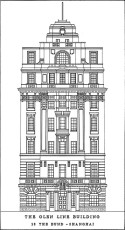
Glen Line Building - Shanghai
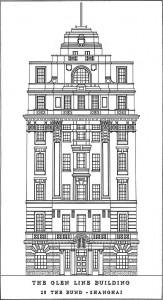
Glen Line Building (No. 2 Beijing Road) today houses the Shanghai Broadcasting Board.
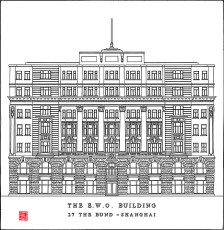
EWO Building - Shanghai
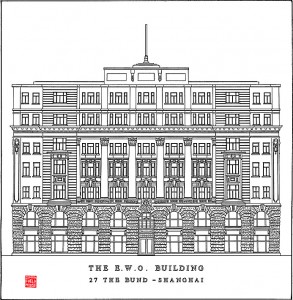
Jardine Matheson Building (No. 27, The Bund) housed the then-powerful Jardine Matheson company.
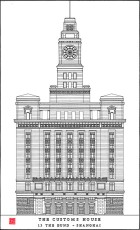
Customs House - Shanghai
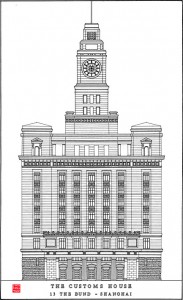
No. 13 The Customs House Building
This building was again demolished in 1925 to make way for the current building, designed by P & T Architects Limited (Palmer and Turner). The new building was completed on December 19, 1927, and cost 4.3 million taels of silver, twice the budget. The building remains a customs house today.
Layout
The present Customs House occupies an area of 5722 m², with 32680 m² of floor space. The building is in two section: the eastern section is eight storeys tall and faces the Huangpu River. It is topped by a clock tower, which is eleven storeys or 90 metres tall. The western section is five stories tall, and faces onto Sichuan Road. A reinforced concrete structure was used. The exterior follows a Greek-revival Neo-Classicist design. The eastern section is entirely surfaced in granite, as are the first two storeys of the western section, with the upper three storeys faced with brown bricks. The main entrance has four Doric columns. Eaves are founda bove the first and second storeys, with a larger one above the sixth floor. Large stone columns penetrate from the third to the sixth storey.
Inside the main entrance is the main hall. Marble columns are decorated with gold leaf. At the centre is an oxtagonal dome, with mosaics on the eight sides.
The most famous feature of the Customs House is the clock tower and clock. The clock tower offers views over the entire Bund and Shanghai city centre. It has four faces, each made up of more than 100 pieces of glass, between 0.3 and 1 metre in size. The diameter of each face is 5.3 metres, with 72 automatic lamps. The clock and bell mechanisms are built according to the design of Big Ben at the Palace of Westminster. The bells were cast by John Taylor Bellfounders and the clock mechanism was built by JB Joyce & Co in England before they were shipped to Shanghai. It remains to be the largest clock in Asia. During the Cultural Revolution, the clock music was changed to The East is Red. The traditional tune (the Westminster Quarters) was restored in the 1980s. In 2003, however, the municipal Communist Party branch ordered the music to be changed once again to The East is Red.
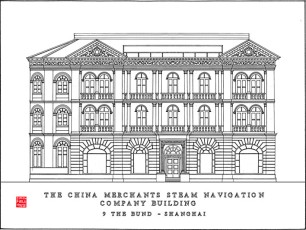
China Merchants Building - Shanghai
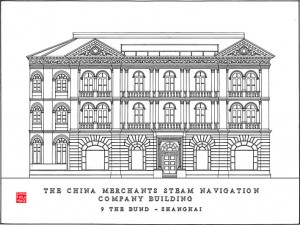
No. 9 The China Merchants Steam Navigation Company Building
The four story China Merchants Bank Building in Shanghai was built in 1907 and later Hospital of Shanghai Changjiang Navigation Company.
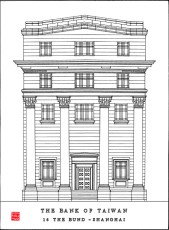
Bank of Taiwan - Shanghai
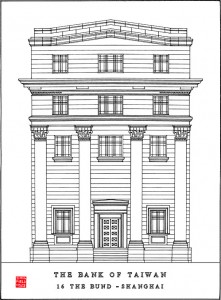
No. 16 Bank of Taiwan Building The Bund is now the China Merchants Bank.
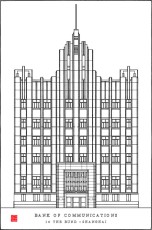
Bank of Communications - Shanghai
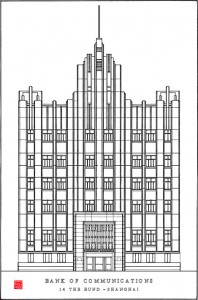
Bank of Communications Limited (BoCom or BoComm) SEHK: 3328 SSE: 601328 (simplified Chinese: 交通银行; traditional Chinese: 交通銀行; pinyin: Jiāotōng Yínháng; often abbreviated as 交行), founded in 1908, is one of the largest banks in China.
Before 1949
The Bank of Communications was founded in 1908 (the 34th year of the Guangxu reign period, Qing Dynasty) and emerged as one of the first few major national and note-issuing banks in the early days of the Republic of China. It was chartered as "the Bank for developing the country's industries". In order to expand business into the overseas arena, the Bank opened its first Hong Kong Branch on 27 November 1934.
[edit] After 1949
[edit] Republic of China
After the Chinese Civil War ended in 1949, the Bank of Communications, like the Bank of China, was effectively split into two operations, part of it relocating to Taiwan with the Kuomintang government. In Taiwan, the bank is also known as Bank of Transportation (交通銀行, Chiao Tung Bank). It eventually merged with the International Commercial Bank of China (中國國際商業銀行), the renamed Bank of China in Taiwan after its 1971 privatization to become the Mega International Commercial Bank (兆豐國際商業銀行).
[edit] People's Republic of China
The mainland operation is the current Bank of Communications.
Following the State Council's decision to restructure the Bank in 1986, the Bank was then restructured and re-commenced operations on 1 April 1987. Since then, its Head Office has been relocated from Beijing to Shanghai.
[edit] Today
Today, the Bank of Communications is amongst the top 5 leading commercial banks in China and has an extensive network of over 2,800 branches covering over 80 major cities. Apart from Hong Kong, the Bank has also established overseas branches in New York, Tokyo, Singapore and representative offices in London and Frankfurt. As of end-2002, the Bank had over 45,000 employees and a total asset reaching RMB 766.874 billion.
The Bank was awarded "The Best Bank in China" by international acclaimed magazines Euromoney and Global Finance in 1998 and 1999 respectively. According to the latest ranking of 1000 banks worldwide conducted by the authoritative magazine The Banker, Bank of Communications was ranked 94th, its first time to join the Top-100 list. In addition, the Feb 2003 edition of The Banker also ranked Bank of Communications 92nd amongst the 100 most efficient lending banks of the world.
A sub-branch of the Bank of Communications Hong Kong Branch.
[edit] Events in 2005
As of January 2005, 19.9% of the bank is owned by HSBC. An HSBC spokeswoman said HSBC Holdings Plc and its 19.9% held Bank of Communications (BoComms) affiliate, would seek to acquire a brokerage to expand their operations in China. The plan was part of HSBC's broader China expansion strategy, but "there is nothing further to disclose at the present." HSBC's operations in China include its own banking operations, its stake in BoCom and an 8% stake in Bank of Shanghai. HSBC also holds a 19.9% stake in Ping An Insurance (Group) Co of China through its wholly owned subsidiary HSBC Insurance Holdings. The South China Morning Post today cited Peter Wong Tung-shun, executive director at The Hongkong and Shanghai Banking Corporation, as saying that the acquisition is being considered in the light of the Chinese government's reforms of the country's securities brokerages. This includes a provision allowing foreign companies to get management control of brokerage firms. Wong did not provide a timetable for any acquisition or identify any acquisition target. The Hongkong and Shanghai Banking Corp is a wholly owned HSBC subsidiary.