


James Thurber (1894–1961) was one of the great comic voices of The New Yorker, celebrated equally as a writer and cartoonist. His deceptively simple drawings, populated by bewildered husbands, formidable women, eccentric creatures and mournful dogs, created an instantly recognisable world of gentle absurdity.
In this 3D portrait I have tried to capture Thurber as a character from his own imagination: slightly stooped, hands buried in his pockets, formally dressed but somehow detached from the ordinary world around him. His expression has the introspective, faintly troubled quality that seems entirely appropriate for a man whose humour so often emerged from anxiety, misunderstanding and the peculiarities of everyday life.
At his feet sits one of Thurber’s unmistakable dogs. Dogs appeared repeatedly throughout his drawings and stories, often possessing more dignity and common sense than their human companions. With their drooping ears, solemn expressions and slightly improbable anatomy, they became an important part of Thurber’s visual language.
Including the dog therefore seemed essential. Rather than simply portraying Thurber himself, the sculpture brings together the artist and one of the enduring inhabitants of the extraordinary comic world he created.
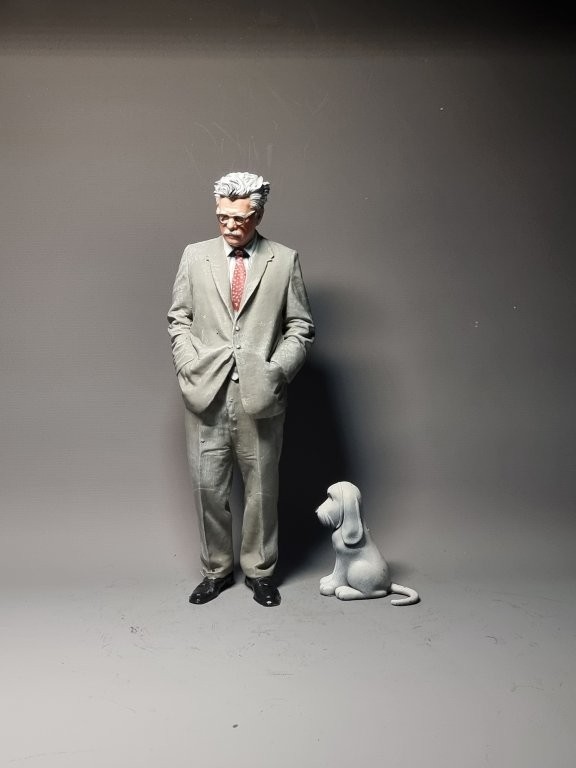
James Thurber
James Thurber (1894–1961) was one of the great comic voices of The New Yorker, celebrated equally as a writer and cartoonist. His deceptively simple drawings, populated by bewildered husbands, formidable women, eccentric creatures and mournful dogs, created an instantly recognisable world of gentle absurdity.
In this 3D portrait I have tried to capture Thurber as a character from his own imagination: slightly stooped, hands buried in his pockets, formally dressed but somehow detached from the ordinary world around him. His expression has the introspective, faintly troubled quality that seems entirely appropriate for a man whose humour so often emerged from anxiety, misunderstanding and the peculiarities of everyday life.
At his feet sits one of Thurber’s unmistakable dogs. Dogs appeared repeatedly throughout his drawings and stories, often possessing more dignity and common sense than their human companions. With their drooping ears, solemn expressions and slightly improbable anatomy, they became an important part of Thurber’s visual language.
Including the dog therefore seemed essential. Rather than simply portraying Thurber himself, the sculpture brings together the artist and one of the enduring inhabitants of the extraordinary comic world he created.